Deal DSL
Define a durable deal as data, then run the same interpreter for any sellable item.
Product requirements
The process represents one buyer's deal for one item. The item can be a dataset, a physical product, a subscription, a service, or another sellable good. It must:
- Accept a definition containing a process ID, item ID and name, initial state, initial state data, states, actions, waits, and transitions.
- Validate the definition before execution. Every referenced state and action must exist, identifiers must be valid, and each condition name must identify one wait point.
- Run InitializeDeal once. It stores an immutable definition snapshot, buyer and item identity, initial state data, and the first state to enter.
- Run WaitForDealCondition before entering a state. If the state declares a precondition, the Step waits for one message on that condition's keyed Channel. Otherwise it proceeds immediately.
- Merge the condition message into DealStateData, then execute the state's actions in their declared order. Each action gets its own ExecuteDealAction execution and durable checkpoint.
- Run EvaluateDealTransition after the actions. It can wait for another external condition, compare one state-data value against ordered equality cases, and select the matching state or the fallback state.
- Repeat the interpreter loop until it reaches a state without a transition. The Flow then completes with the accumulated state data.
- Keep running executions independent from later definition edits. The Go application stores editable definitions in PostgreSQL and passes a snapshot into each new Flow.
The Flow waits for precondition messages, transition messages, and retry delays after a failed Step attempt. A wait does not occupy a Worker.
Potential failures include:
- Definition validation can reject a missing item, an unknown initial or destination state, a duplicate condition name, an invalid identifier, or an unregistered action.
- A condition message can be malformed, target an unknown or stopped Flow, or arrive for a condition that the definition does not expose.
- A condition result is invalid unless exactly one message satisfies the keyed wait. The Step fails instead of merging ambiguous input.
- Payment, refund, sample delivery, or item delivery can time out or return an error. Dex retries the failed Step without rerunning earlier completed actions.
- An action can succeed remotely while its response is lost. Production adapters should use the Flow ID and Step execution identity as an idempotency key.
- State data can omit a decision key. The transition then follows its explicit fallback state.
- A definition can contain a business loop with no eventual external decision. The Flow remains durable, but product-level validation or timeouts must bound unwanted loops.
Flow design
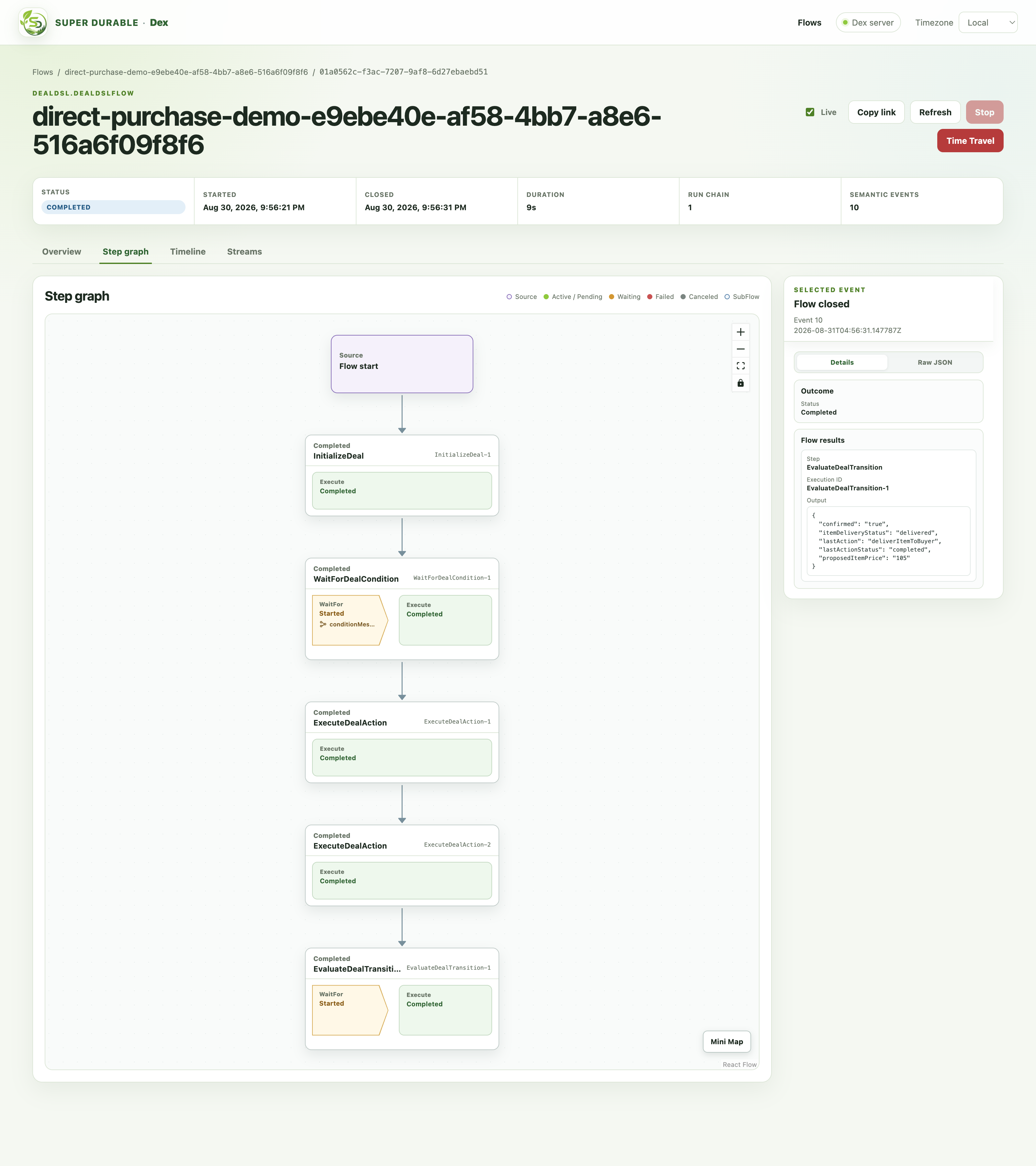
This interactive definition graph is generated from the runnable Python Flow.
The Flow is a small durable interpreter. A definition chooses the business path; four Step types provide the execution machinery:
DealStart(definition snapshot, buyer, item)
                    │
                    ▼
              InitializeDeal
                    │
                    ▼
          WaitForDealCondition ◄──────────────┐
          wait on keyed Channel              │
                    │                         │
                    ▼                         │
           ExecuteDealAction                 │
       one execution per ordered action      │
                    │                         │
                    ▼                         │
         EvaluateDealTransition              │
       optional wait + case / fallback       │
                    │                         │
             next state? ── yes ─────────────┘
                    │ no
                    ▼
       complete with accumulated state data
It combines these design patterns:
- Interpreter keeps the executable Flow stable while process definitions supply states, waits, actions, and transitions.
- Finite-state machine makes the current state and every transition explicit and inspectable.
- Immutable execution snapshot prevents an edit to the catalog definition from changing an in-flight deal.
- Keyed Channel rendezvous maps each named external condition to its own durable inbox without creating one Channel definition per condition.
- One-action checkpoint isolates retries and records the exact action that failed. Ordered actions never collapse into one opaque Step.
- Guarded transition with fallback evaluates ordered equality cases against shared state data and always has an explicit default path.
- Blackboard state lets condition messages and actions contribute small key-value updates to one durable DealStateData map.
- Entity store gives each Go execution a stable Flow ID and searchable process, item, buyer, current-state, and pending-condition Attributes.
The portable SDK examples use one action list per state. The Go product example extends the same loop with separate pre-actions and post-actions, a PostgreSQL definition catalog, search endpoints, and a browser UI.
Core implementation
Each tab includes the Flow signature, persistence schema, and the complete four-Step interpreter path. Every snippet comes from the linked runnable example.
class DealDSLFlow(Flow[DealStart]):
    definition = Attribute("DealDefinition", DealDefinition)
    state_data = Attribute("DealStateData", dict[str, str])
    process_id = Attribute("DealProcessID", str)
    item_id = Attribute("DealItemID", str)
    buyer_id = Attribute("DealBuyerID", str)
    current_state = Attribute("DealCurrentState", str)
    pending_condition = Attribute("DealPendingCondition", str)
    condition_messages = ChannelMap("DealConditionMessages", dict[str, str])

    def __init__(self) -> None:
        self.initialize = InitializeDeal(self)
        self.wait_for_condition = WaitForDealCondition(self)
        self.execute_action_step = ExecuteDealAction(self)
        self.evaluate_transition = EvaluateDealTransition(self)

    def get_steps(self) -> StepList[DealStart]:
        return StepList.start_step(self.initialize).other_steps(
            self.wait_for_condition,
            self.execute_action_step,
            self.evaluate_transition,
        )

    def get_persistence_schema(self) -> PersistenceSchema:
        return PersistenceSchema.of(
            self.definition,
            self.state_data,
            self.process_id,
            self.item_id,
            self.buyer_id,
            self.current_state,
            self.pending_condition,
            self.condition_messages,
        )


class InitializeDeal(Step[DealStart]):
    def execute(self, context: Context, input: DealStart) -> StepDecision:
        definition = input.definition
        definition.state(definition.initial_state)
        self.flow.definition.set(context, definition)
        self.flow.process_id.set(context, definition.process_id)
        self.flow.item_id.set(context, definition.item_id)
        self.flow.buyer_id.set(context, input.buyer_id)
        self.flow.state_data.set(context, dict(definition.initial_state_data))
        return go_to(WaitForDealCondition, StateStepInput(definition.initial_state))


class WaitForDealCondition(Step[StateStepInput]):
    def wait_for(self, context: Context, input: StateStepInput) -> Wait:
        state = self.flow.definition.get(context).state(input.state_name)
        if state.pre_condition is None:
            return Wait.skip_immediately()
        self.flow.pending_condition.set(context, state.pre_condition.name)
        return Wait.until(self.flow.condition_messages.for_one(state.pre_condition.name))

    def execute(self, context: Context, input: StateStepInput) -> StepDecision:
        state = self.flow.definition.get(context).state(input.state_name)
        if state.pre_condition is not None:
            self.flow.merge_condition(context, state.pre_condition.name)
            self.flow.pending_condition.delete(context)
        self.flow.current_state.set(context, state.name)
        if state.actions:
            return go_to(ExecuteDealAction, ActionStepInput(state.name, 0))
        return go_to(EvaluateDealTransition, input)


class ExecuteDealAction(Step[ActionStepInput]):
    def execute(self, context: Context, input: ActionStepInput) -> StepDecision:
        state = self.flow.definition.get(context).state(input.state_name)
        if input.action_index < 0 or input.action_index >= len(state.actions):
            raise ValueError(f"invalid action index {input.action_index}")
        self.flow.execute_action(context, state.actions[input.action_index])
        next_index = input.action_index + 1
        if next_index < len(state.actions):
            return go_to(ExecuteDealAction, ActionStepInput(state.name, next_index))
        return go_to(EvaluateDealTransition, StateStepInput(state.name))


class EvaluateDealTransition(Step[StateStepInput]):
    def wait_for(self, context: Context, input: StateStepInput) -> Wait:
        transition = self.flow.definition.get(context).state(input.state_name).transition
        if transition is None or transition.wait_for is None:
            return Wait.skip_immediately()
        self.flow.pending_condition.set(context, transition.wait_for.name)
        return Wait.until(self.flow.condition_messages.for_one(transition.wait_for.name))

    def execute(self, context: Context, input: StateStepInput) -> StepDecision:
        transition = self.flow.definition.get(context).state(input.state_name).transition
        if transition is None:
            return graceful_complete(self.flow.state_data.get(context))
        if transition.wait_for is not None:
            self.flow.merge_condition(context, transition.wait_for.name)
            self.flow.pending_condition.delete(context)
        state_data = self.flow.state_data.get(context)
        next_state = transition.else_state
        for deal_case in transition.cases:
            if state_data.get(transition.key) == deal_case.equals:
                next_state = deal_case.go_to_state
                break
        return go_to(WaitForDealCondition, StateStepInput(next_state))
Example: examples/python/dex_examples/products/deal_dsl/deal_dsl_flow.py
Demo
This completed Go run sold the Premium research package item to buyer-demo. The Flow waited for buyer-confirmation, charged the buyer, delivered the item, and completed with itemDeliveryStatus: delivered. Each action appears as a separate completed ExecuteDealAction execution.