Application operation
Your Dex application is the Worker service that hosts Flow definitions and handles WaitFor, Execute, and Worker RPC calls. Operate it as a production service: record the deployed version, expose useful logs, and keep its network path to Dex Server healthy.
Worker API availability
When a Worker cannot receive or complete a Step call, a Flow cannot advance. You may see a Step remain active, retries increase, or a terminal failure after the retry policy is exhausted.
Check these items in order:
- Collect the Flow ID, Run ID, Flow type, Worker version, and Dex Server address. Put them in the incident record before changing anything.
- Check the Worker logs for handler exceptions, registration failures, and startup configuration. Include the Flow ID or Run ID in log searches.
- Check the network route from Dex Server to the Worker: service discovery, address, TLS, authentication, and any load-balancer health checks.
- Confirm that the deployed Worker registered the Flow, Step, and RPC names used by the open Flow. A deployment can be healthy while an old Step type is missing from that Worker version.
- Inspect the affected Step in Dex Web. The retry attempt, Worker error, gRPC status, and stack trace distinguish an unavailable Worker from an application failure.
After fixing availability, let an active retry continue when its retry budget is still valid. For a terminal Flow, verify the fix with a new run first, then use Time Travel from a safe Step boundary when that is the intended recovery. Do not restart or time travel a Flow merely to test connectivity.
Flow failure and timeout
A Flow can fail because a Worker handler returns a failure, Worker retries are exhausted, or the Flow reaches its configured timeout.
Flow timeouts are durable Dex timers configured when a Flow starts; zero disables them. Choose FAIL, CANCEL, or a Flow timeout handler. Inspect the start event for the configured duration and resolved policy. A continue-as-new run keeps the original absolute deadline; a retry starts with a fresh timeout budget.
Every positive timeout has one internal sys:timeout_handler timer. It is visible in active-Step diagnostics and SkipTimer can fire it early by timer index. Fix the underlying cause before recovering a failed timeout.
Read-only debugging workflow
Start with Dex Web. It shows the durable, application-level record before you need to inspect raw JSON.
1. Select the relevant event
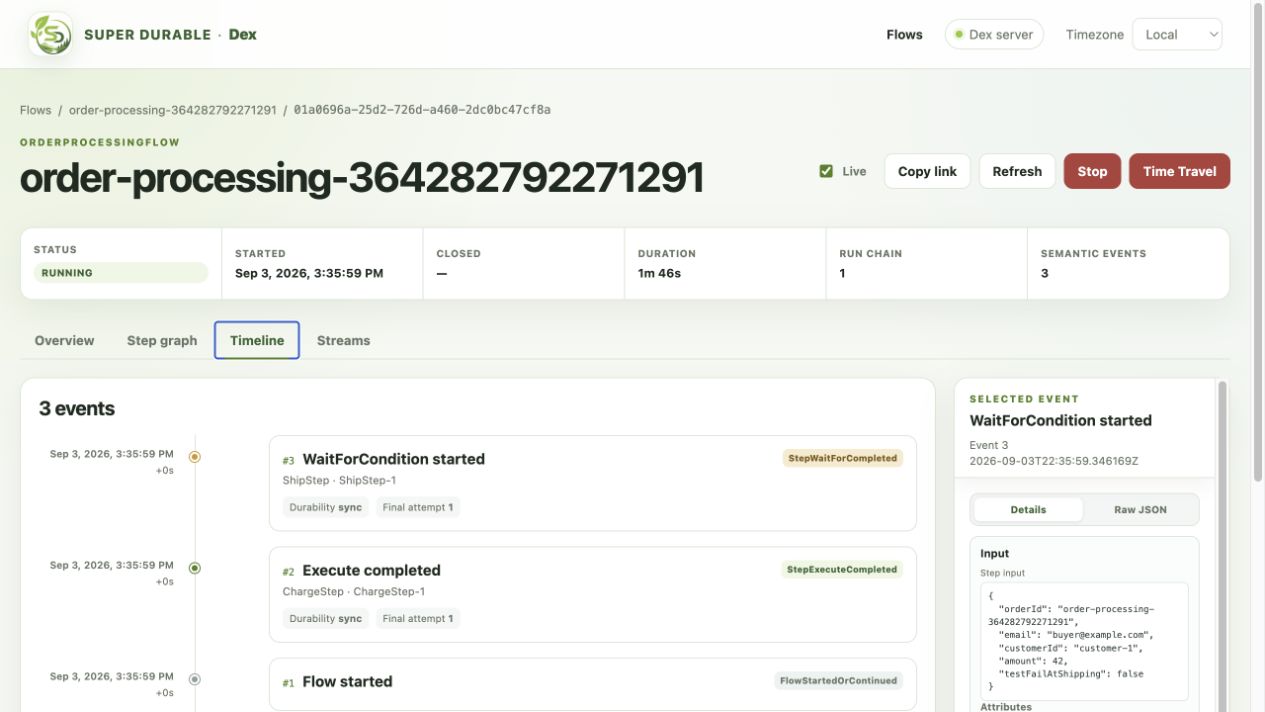
Open the Flow by Flow ID and Run ID, choose Timeline, then select the Step event that is waiting, completed, or failed. The right-side Selected event panel identifies the event number and its type.
2. Read inputs, Attributes, conditions, and outputs
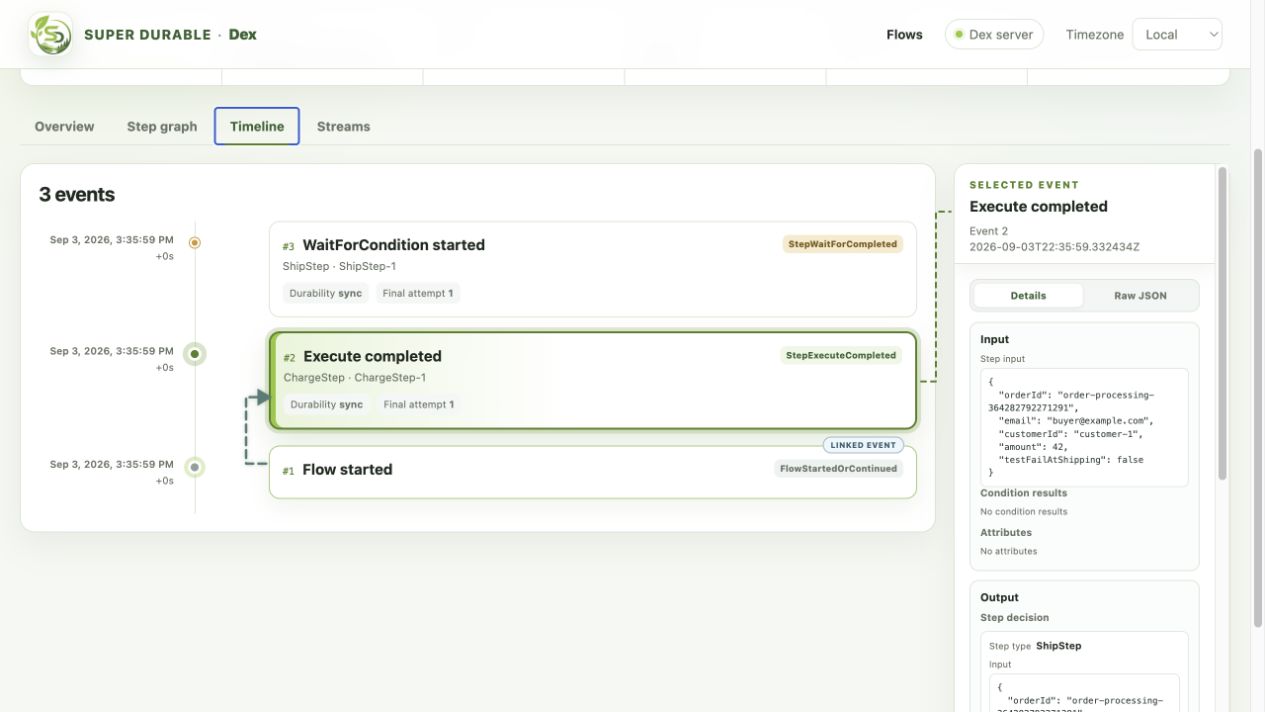
In Details, read Input first. The panel shows the Step input, durable Attributes, and condition results available at that event. For a completed Step, continue to Output to inspect the Step decision, the next Step input, and resulting Attribute changes.
3. Expand a failed Step's stack trace
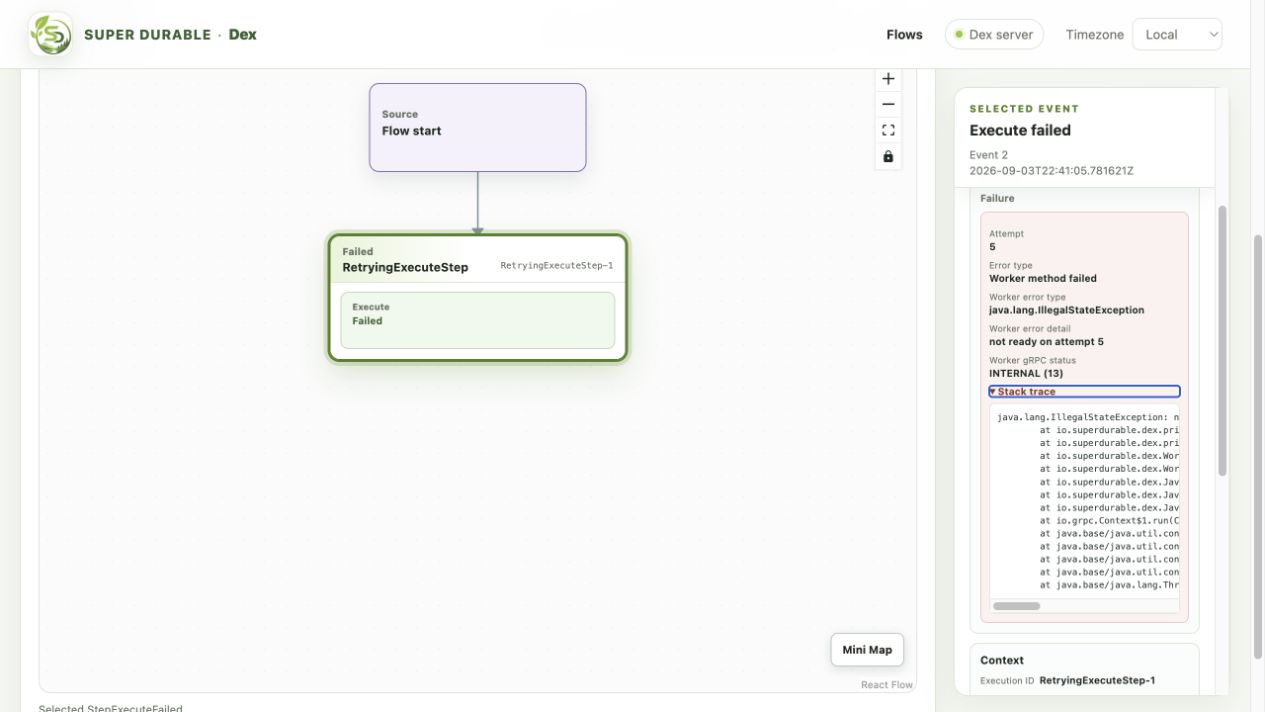
For a retrying or failed Step, select the failed event from Timeline or the failed node from Step graph. Under Failure, compare the attempt, Worker error type, error detail, and gRPC status. Expand Stack trace before asking the owning team to investigate.
These screenshots use the repository's synthetic Java examples. They contain no credentials or production customer records.
4. Save auditable JSON with dexcli
Use the same Flow ID and Run ID in the CLI. These commands are read-only and print JSON, so attach their output to an incident or retain it in secure diagnostic storage.
dexcli flow inspect FLOW_ID --run-id RUN_ID

dexcli flow history FLOW_ID --run-id RUN_ID --all

dexcli flow inspect FLOW_ID --run-id RUN_ID --all-history --no-hydrate

dexcli flow history FLOW_ID --run-id RUN_ID --all --no-hydrate
dexcli flow inspect returns the current Flow summary and state when it is available. dexcli flow history returns semantic events. Use --all to retrieve every history page. Use --no-hydrate when payloads may be large or sensitive: the output retains blob references instead of fetching their contents.
5. Ask the Dex Developer skill for an investigation
The Dex Developer skill can guide a repository-aware investigation. Give it the identifiers and require a read-only first pass. For example:
$dex-developer Diagnose Dex Flow FLOW_ID, Run ID RUN_ID. The Worker version is
WORKER_VERSION and Dex Server is SERVER_ADDRESS. First perform read-only checks:
inspect Dex Web, application logs, dexcli flow inspect, and dexcli flow history
with --all. Do not stop, time travel, restart, or otherwise modify a Flow unless
I explicitly authorize that action. Report the suspected failing Step, evidence,
and the safest recovery option.
Versioning Flow code
Dex does not replay your Flow handler code to decide later transitions, so a deployment does not produce a user-code replay nondeterminism error. That does not remove compatibility work. Open Flows can still observe changed business rules, unavailable Step implementations, renamed RPCs, or incompatible data.
Lock business behavior at Flow start
Persist a business version value when a Flow starts, such as an Attribute or a field in the start state. Branch on that stored value, not on the Worker build currently serving the call. Existing Flows keep their old behavior; new Flows can use the new behavior after deployment.
Use this when a change alters a decision, payment rule, retry policy, deadline, or other customer-visible meaning. A code rollout alone is not a versioning strategy because a long-running Flow can call a newly deployed Worker later.
Evolve data and contracts additively
Add optional fields. Readers must tolerate absent fields from older runs and ignore unknown fields sent by newer components. Supply a safe default for an absent field, and keep the previous meaning of existing field values. For an incompatible payload or output contract, introduce a new Step type or RPC name instead of silently changing the old one.
Keep old definitions until old Flows finish
Do not delete or rename a Flow type, Step type, or RPC implementation while an open Flow can still call it. Deploy the new definition alongside the old one, route only new-version Flows to it, and keep the old implementation available through retries, continue-as-new runs, and any approved Time Travel recovery.
Before removing the old definition, search for the legacy Flow type and confirm that no running, waiting, retrying, or recoverable terminal Flow needs it. Keep the search result with the change record. The exact query depends on your visibility-store fields; begin with a bounded Flow-type search such as:
dexcli flow search --query 'FlowType = "OldFlowType"'
Only remove the old code after the result is empty or every remaining Flow has an explicitly approved retirement plan.